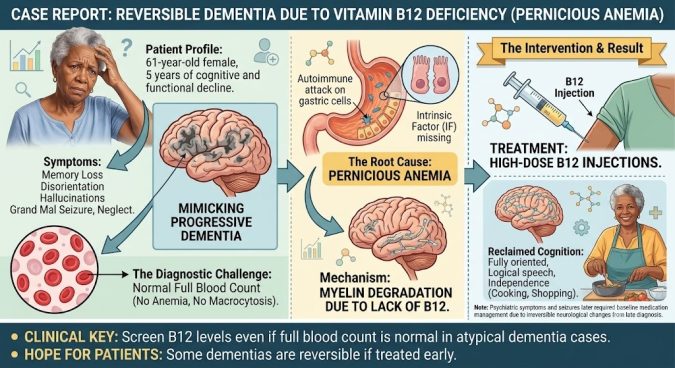
When a 61-year-old woman from Cape Verde began wandering the streets barefoot, talking to invisible visitors, and neglecting her home, her family watched in despair. For five long years, her cognitive and functional health slowly unraveled. By the time her sister brought her to Portugal for medical evaluation, the woman had suffered a sudden, violent grand mal seizure.
To any clinician or relative, the trajectory looked tragically familiar: a textbook case of advanced, irreversible neurodegenerative dementia combined with late-onset psychosis and epilepsy.
Yet, beneath the terrifying symptoms lay a profound medical mystery. Her blood work showed no signs of anemia, and her red blood cells were perfectly normal in size—completely masking the traditional warning signs doctors look for when testing for nutritional deficits.
It was only when medical teams looked past the standard blood counts and measured her specific nutrient levels that they discovered the culprit: an extreme deficiency of Vitamin B12, triggered by an autoimmune condition known as pernicious anemia.
The Invisible Cause
Pernicious anemia is a silent assailant. It causes the immune system to mistakenly attack the gastric cells responsible for producing intrinsic factor—a crucial protein required for the intestines to absorb Vitamin B12 from food.
Without B12, the nervous system loses its protective insulation, known as myelin. This breakdown can mimic Alzheimer’s disease or primary psychiatric disorders. According to the publishing physicians from the NOVA Medical School in Lisbon, what makes this case remarkably dangerous is how easily it was overlooked. Because the patient lacked the classic physical signs of vitamin deficiency—such as a swollen tongue or abnormal blood cell shapes—her underlying condition remained hidden while her brain sustained ongoing damage.
Medical literature reveals that roughly 28% of patients suffering from neuropsychiatric issues due to a low B12 status actually display completely normal blood counts. This leaves a massive blind spot in standard diagnostic routines.
A Rapid Awakening
Once the true cause was unmasked, the medical team initiated a targeted treatment plan. Alongside temporary antipsychotic medication to quiet her hallucinations, the patient began receiving high-dose intramuscular injections of Vitamin B12.
What followed was nothing short of extraordinary.
With the sudden influx of the missing nutrient, the woman’s cognitive faculties began to repair themselves. The mental fog lifted. She became fully oriented in time and space, her speech regained its logical structure, and she successfully reclaimed her independence. Soon, she was cooking, shopping, and managing her daily routine once again—a stunning reversal for someone who had been entirely incapacitated.
The Cost of Delay
However, the human brain has limits to its resilience. While the patient’s memory and daily functional skills returned completely, her psychiatric symptoms and seizures eventually resurfaced when doctors tried to stop her baseline medications.
The researchers note that the five-year delay in finding the root cause likely left permanent neurological scars. When nerve pathways are deprived of B12 for too long, the brain cells become highly vulnerable to chemical stress, creating lasting sensitivities that require long-term management with specialized medication.
Lessons for the Clinic
This case, published in BMJ Case Reports, serves as a powerful reminder for families, patients, and physicians alike. Dementia is a devastating diagnosis, but it should never be accepted without exhaustive investigation.
Medical professionals suggest that when an individual presents with atypical psychiatric distress, rapid memory decline, or unexplained seizures, checking Vitamin B12 levels—and checking secondary markers like serum homocysteine—should be a mandatory priority.
For families witnessing a loved one slip away into cognitive decline, this story offers a vital piece of advocacy: sometimes, the mind isn’t permanently gone. Sometimes, it is simply locked away, waiting for the right key to turn.