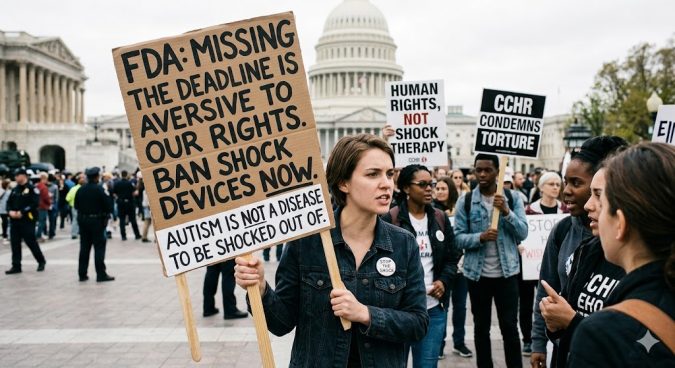
The Food and Drug Administration (FDA) has missed its regulatory deadline to implement a federal ban on electrical stimulation devices (ESDs) used as aversives for behavior modification in autistic and developmentally disabled individuals. The administrative delay has drawn sharp condemnation from human rights organizations and medical professionals, who warn that prolonged inaction leaves vulnerable populations at continued risk of physical and psychological trauma.
The device in question, historically categorized as a Graduated Electronic Decelerator (GED), is designed to administer high-amperage, contingent skin shocks in two-second bursts via electrodes attached to a patient’s limbs or torso. Proponents of the technology use it to suppress severe self-injurious or aggressive behaviors. However, the mechanism has faced decades of intense opposition from clinicians, bioethicists, and international bodies.
A Controversial Regulatory Trajectory
The FDA previously attempted to outlaw ESDs for behavior modification in 2020, asserting that the devices present an unreasonable and substantial risk of illness or injury. That initial ban was subsequently overturned by a federal appeals court, which ruled the agency had exceeded its statutory authority by interfering with the practice of medicine.
In response, Congress enacted a targeted legislative provision in 2023, explicitly granting the FDA the legal authority required to ban the devices for aversive therapy. Armed with this legislative mandate, the FDA issued a newly proposed rule to enact the ban in March 2024. The expiration of the recent deadline without a finalized, enforceable rule has sparked renewed urgency across the healthcare advocacy landscape.
Clinical Consensus and Expert Condemnation
According to FDA findings, the potential clinical harms associated with ESDs are extensive, encompassing severe skin burns, acute tissue damage, chronic stress, nightmares, flashbacks, and an elevated risk of suicidality.
The rejection of this practice extends deeply into the professional associations responsible for developing behavioral intervention standards. Major industry groups, including the Association for Behavior Analysis International (ABAI), have issued formal position statements strongly opposing the use of contingent electric skin shocks under any condition.
Experts note that modern behavioral science has evolved past pain-based deterrents. Commenting on the systemic rejection of these devices within the medical community, prominent disability rights scholars and autism experts emphasize that aversive conditioning fails to address the root causes of severe behaviors.
“Subjecting people with disabilities to electrical shocks for conduct that others find disruptive or dangerous is both morally and medically unjustifiable,” stated a coalition of over 30 leading developmental disability organizations in a joint brief to federal legislators. “The medical evidence that this is an ineffective and harmful intervention is clear. The practice relies on producing pain in people who often have limited ability to communicate, creating a perfect paradigm for severe psychological trauma and learned helplessness.”
Medical leadership mirrors this stance. Following the FDA’s March 2024 proposed rule, Dr. Benjamin Hoffman, President of the American Academy of Pediatrics (AAP), issued a stark warning regarding the utilization of high-voltage shocks on disabled youths. Dr. Hoffman noted that the intervention places recipients “at high risk for both physical and psychological traumas” and cautioned that the administration of pain can paradoxically exacerbate the very aggressive or self-injurious behaviors it aims to mitigate.
Furthermore, international human rights monitors have repeatedly scrutinized the intervention. As early as 2012, Juan Mendez, the United Nations Special Rapporteur on Torture, formally declared that the application of electric current through a patient’s body under these conditions constitutes a violation of human rights, stating that “the passage of electricity through anybody’s body is clearly associated with pain and suffering.”
The Ideological Battle Against Coercive Controls
The opposition to physical and electrical coercion in behavioral management is rooted in a long-standing ideological debate within modern psychiatry and psychology. Critics argue that utilizing physical pain to manage behavioral expressions represents a failure of therapeutic care, transforming medical interventions into simple mechanisms of social control.
This critique was famously championed by Dr. Thomas Szasz, a renowned author and professor of psychiatry at the State University of New York Medical Center, who spent his career challenging the moral legitimacy of forced interventions. Dr. Szasz argued that evaluating human behavior purely through a lens of institutional compliance strips individuals of their autonomy.
“Electric shock treatment is paradigmatic of interventions based on force and justified by ‘medical necessity,'” Dr. Szasz observed regarding institutional behavioral modifications. He argued that utilizing physical distress as a tool for behavior control “requires the sacrifice of the patient as a person,” warning that treating behavioral differences with physical force reduces complex human struggles to a mere matter of conditioning and restraint.
Advocacy Call for Comprehensive Reform
The Citizens Commission on Human Rights (CCHR) International—a mental health watchdog co-founded by Dr. Szasz to lobby against coercive psychiatric and psychological practices—has called the regulatory delay an unacceptable failure in public safeguarding.
“In an era where there is international condemnation of coercive psychiatric practices, any electrical device used to force changes in behavior, emotion, and mental problems should be prohibited,” said Jan Eastgate, President of CCHR International, in a statement regarding the missed deadline. Eastgate emphasized that the ongoing tolerance of ESDs reflects a broader systemic reluctance to regulate electrical interventions, including electroconvulsive therapy (ECT) devices.
CCHR, which has previously successfully campaigned for statutory bans on electroshock treatments for minors in states like Texas and California, recently submitted formal comments to the FDA demanding an immediate, comprehensive ban on all behavioral uses of skin-shock devices.
The organization is joined by a coalition of more than 100 advocacy groups, including the Stop the Shock Coalition, pushing for state and federal legislation to categorize the practice under anti-torture statutes, rather than relying solely on federal administrative timelines.