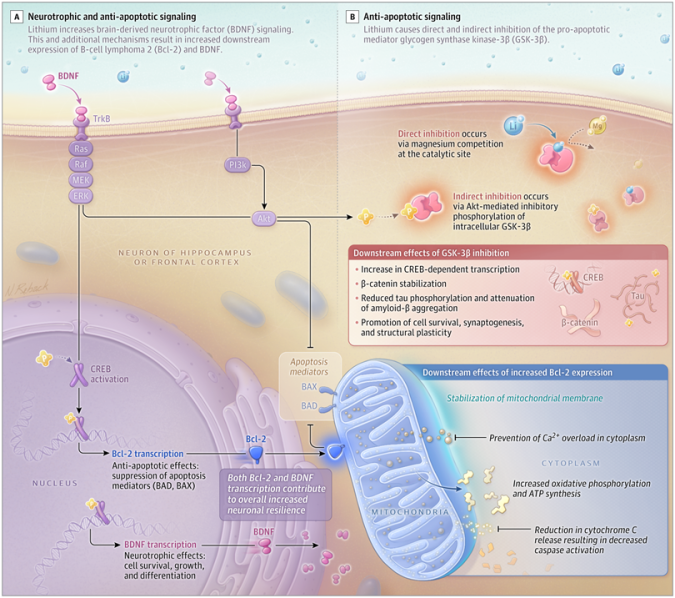
Lithium, the gold-standard treatment for bipolar disorder, may play a crucial role in modifying or stopping the progression of Alzheimer’s disease. This groundbreaking, hopeful conclusion comes from a recently published narrative review that gathered a long series of preclinical and clinical studies performed in vitro, in vivo, in mouse models, and in bipolar and dementia patients. The careful comparison of these studies led the researchers to validate the positive effects of lithium not only for psychiatric illnesses, but also for mild cognitive decline, dementia, and above all, for Alzheimer’s disease.
The Core of The Narrative Review
Through an in-depth examination of studies spanning 25 years across the United States, the United Kingdom, and Northern Europe, researchers found evidence that low doses of lithium exert neurotrophic and neuroprotective effects, improving brain function and grey matter volume and modifying the pathological conditions and vulnerabilities that can trigger neurodegenerative diseases. According to the researchers’ conclusion, lithium influences and mitigates the mechanisms involved in neurodegeneration. These mechanisms include toxic protein accumulation, mitochondrial dysfunction, and oxidative stress. Lithium also regulates processes of cellular apoptosis, modifying proteins that induce neural death. It can also increase BDNF (Brain-derived neurotrophic factor), a pivotal protein for cell survival and growth. In short, the hypothesis is that lithium may promote neuroregeneration.
“Importantly, these mechanisms intersect directly with the biology of key neurodegenerative diseases. Alzheimer disease, for instance, is increasingly understood as a disease not solely associated with amyloid plaque accumulation but as a progressive cellular vulnerability marked by mitochondrial dysfunction, impaired trophic signaling, synaptic loss, and apoptotic activation. Lithium intervenes, modifying these crucial brain pathways involved in neurodegeneration,” the researchers said.
Lithium and Dementia
Lithium, a salt found in rocks, has been the primary treatment for bipolar disorder for 75 years. Also used in manufacturing, lithium carbonate formulation has traditionally been used as a mood stabilizer for mania and bipolar depression. The latter is now considered a progressive psychiatric disorder with neurological implications, which can cause gray matter reduction in the brain and cognitive decline. Bipolar disorder, indeed, shares the same pathogenic mechanisms leading to neurodegeneration, such as chronic stress and mitochondrial dysfunction. However, according to the study, the formulation with major benefits for dementia is not lithium carbonate (the ionic carbonate lithium salt), but lithium orotate, aka a lithium salt with orotic acid.
This formulation is commonly used and sold as a food supplement. Still, the narrative review found evidence that low doses of lithium orotate are more effective and less toxic than lithium carbonate. To exert its effects, lithium carbonate must be administered at high doses (0.6-1 mM), compared with 0.3 mM of lithium orotate. High-dose lithium is toxic to the kidneys and thyroid (it can cause hypothyroidism), whereas low-dose lithium is safe, inexpensive, and can be relevant in low- and middle-income countries. Moreover, lithium orotate crosses the blood-brain barrier as lithium carbonate does.
“Lithium occupies a unique and historically important position in neuropsychiatry… For decades, however, it was viewed narrowly as a mood stabilizer. Over time, and especially recently, this perspective has broadened. Cellular, neurobiological, and translational studies now indicate that lithium’s efficacy derives not from isolated neurotransmitter effects but from modulating upstream signaling networks that regulate apoptosis, mitochondrial bioenergetics, oxidative stress, and neurotrophic support,” researchers stated in their study.
Clinical trials performed in Alzheimer’s patients in the United Kingdom and Denmark have found that the benefits of low-dose lithium orotate are evident for early-stage dementia, while no positive outcomes are yet reported for advanced stages of the disease.
“Evidence from randomized clinical trials has been more mixed. Much of the negative literature likely reflects studies of short treatment duration, advanced disease stage, or behavioral end points rather than neurodegeneration. These limitations constrain the ability to test lithium’s hypothesized neuroprotective mechanisms, which are more likely to influence disease progression over months to years rather than weeks. Disease stage may also be critical. For instance, several studies that reported favorable signals focused on amnestic MCI or early AD with longer treatment periods (12-24 months), whereas many negative trials enrolled patients with established dementia,” researchers said in their study.
Conclusion
A study in 2025 found that Alzheimer’s patients had lithium deficiency in the brain tissues involved in neurodegeneration. Other studies mentioned in the narrative review also found that populations who drink lithium-rich water had a lower risk of developing dementia. These data provide clear clues on the benefits of this drug.
However, further clinical trials are needed to determine whether lithium has neuroprotective effects for preventive or therapeutic purposes in Alzheimer’s disease. We all hope these future trials will be successful.
Source of the Study and Image: JAMA Psychiatry