By Dr. Giorgio Sciarra from Umberto I Polyclinic in Rome
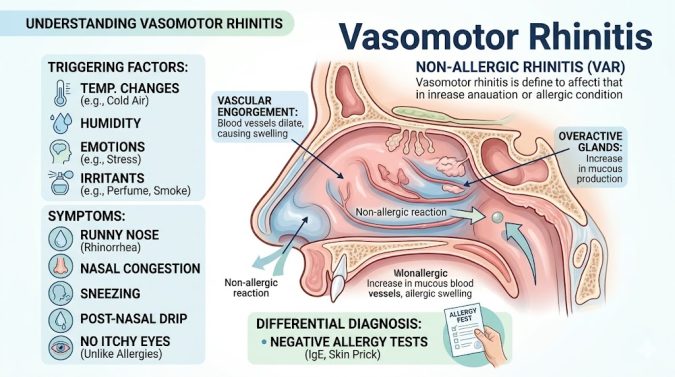
The term “vasomotor rhinitis” is commonly used to describe a clinical condition characterized by the common symptoms of rhinitis (e.g., sneezing, runny nose, nasal congestion, and postnasal drip) associated with non-allergic and non-infectious triggers, such as changes in barometric pressure, humidity, temperature, or exposure to strong odors, fumes, dust, tobacco smoke, and certain foods.
However, the term “vasomotor” can be misleading because it fails to clearly establish the pathogenic mechanism and can encompass variable symptoms. Therefore, several other medical terms are used to describe this same condition: non-allergic idiopathic rhinitis, non-allergic and non-infectious rhinitis, and intrinsic rhinitis.
Rhinitis, in its allergic and non-allergic forms, is very common, affecting approximately 20% of the population in developed countries. Among patients with vasomotor rhinitis, a greater proportion of women has been noted.
What are the causes of vasomotor rhinitis?
No known pathogen causes chronic vasomotor rhinitis. Instead, this condition appears to be triggered by increased sensitivity to environmental factors, such as climate change, pollution, strong odors, and perfumes.
However, recent studies have identified novel mechanisms that may be responsible for this pathological process. These include a local mechanism mediated by immunoglobulin E (IgE) known as entopy, dysfunction of the nociceptive fibers innervating the nasal mucosa, or autonomic dysfunction. In particular:
Entopy. The term entopy refers to a form of allergy localized to the nasal cavity in the absence of positive skin tests, elevated serum IgE, or serum allergen-specific IgE. The presence of a high density of inflammatory cells in the nasal mucosa causes this localized IgE production, without generating a systemic allergic picture.
Nociceptive dysfunction. Chemical and mechanical stimuli, such as heat, cold, discomfort, touch, etc., reaching the nasal mucosa are transported by sensory nerve endings to the cerebral cortex, which allows us to perceive their sensation. Certain chemical mediators produced by our cells, such as bradykinin, histamine, and amines, can also stimulate receptors on the nasal mucosa and activate nerve fibers. Some studies have demonstrated alterations in these nerve fibers in subjects with vasomotor rhinitis, resulting in hyperreactivity, generating hyperalgesia (increased sensitivity to pain) and allodynia (perception of a painful sensation following a harmless stimulus).
Therefore, in people suffering from vasomotor rhinitis, these nerve fibers become hypersensitive to any stimulus, even the most innocuous and trivial, triggering rhinitis as a defense reaction. Autonomic dysfunction. The autonomic nervous system, also known as the vegetative or visceral nervous system, is the set of nerve cells and fibers that innervate internal organs and glands, performing functions that are generally beyond voluntary control.
The autonomic nervous system is further divided into the sympathetic and parasympathetic nervous systems: these two systems typically perform opposing actions and together balance the functioning of our body. In a series of studies conducted on subjects with vasomotor rhinitis, autonomic nervous system dysfunction was confirmed: it appears that in these subjects, the sympathetic nervous system is underactive, resulting in an imbalance between the parasympathetic and sympathetic nervous systems.
What are the symptoms of vasomotor rhinitis?
The clinical manifestations of vasomotor rhinitis can be divided into two forms: obstructive and secretory. The former is characterized by a stuffy nose and severe congestion, while the latter by a severe runny nose. Concomitant ocular symptoms tend to be minimal, and nasal and palatal itching, as well as sneezing, are rare. However, headache, postnasal drip, facial pressure, throat clearing, and cough are common symptoms in these cases.
The two forms of rhinitis appear to have different underlying causes: the obstructive form is more associated with nociceptive dysfunction, while the secretory form is more associated with autonomic dysfunction.
Vasomotor rhinitis is generally perennial and not worsened by exposure to allergens, unlike allergic rhinitis. However, seasonal exacerbations can occur with rapid changes in temperature, humidity, or pressure. Therefore, during spring and autumn, it is easy to confuse vasomotor rhinitis with seasonal allergies.
How is vasomotor rhinitis diagnosed?
The diagnosis is based on clinical history and the exclusion of other known causes of rhinitis, such as allergic, infectious, inflammatory, or immunological rhinitis.
The onset of nasal symptoms in patients over 35 years of age with no history of atopy, seasonal variation, or specific symptoms related to allergen exposure, but induced by nonspecific environmental triggers, suggests a greater than 99% probability of a diagnosis of vasomotor rhinitis, especially in the absence of other symptoms or pathologies.
The nasal mucosa of patients with vasomotor rhinitis is usually normal; in some cases, it may appear edematous and red. Nasal and peripheral eosinophilia is absent. Skin tests and allergen-specific serum IgE tests are usually negative.
How is vasomotor rhinitis treated?
After a diagnosis of vasomotor rhinitis, every measure should be taken to avoid environmental triggers as much as possible, particularly pungent odors, car or cigarette fumes, temperature changes, and hot and spicy foods.
The most commonly used medications to treat the symptoms of chronic non-allergic rhinitis include intranasal steroids, topical antihistamines, and anticholinergics (ipratropium bromide), the latter particularly for the treatment of rhinorrhea.
The most appropriate management of this clinical condition should include a stepwise pharmacological approach, with the initial treatment chosen based on the patient’s predominant symptoms. If obstructive symptoms predominate, an intranasal steroid is the treatment of choice. Conversely, if secretory symptoms predominate, it is more appropriate to begin with a topical anticholinergic. Finally, if both forms of rhinitis coexist, a topical antihistamine is the most appropriate treatment. If single therapy is ineffective, combination treatments can be used.
These medications can be used for long periods, as needed, or before exposures that may exacerbate symptoms. Other additional medical treatments to consider include decongestants, nasal irrigation with saline sprays, or topical nasal capsaicin.
A series of surgical procedures may also be considered, if indicated by an ENT doctor, when medical management fails. These include:
- Turbinectomy, or the partial or complete removal of the turbinates (small bony protrusions on the sides of the nasal septum), can be performed to reduce nasal congestion. However, this procedure can cause long-term dryness and crusting due to increased intranasal airflow and decreased secretions, to the point of causing atrophic rhinitis.
- Vidian nerve resection
- Electrocoagulation of the anterior ethmoid nerve.
Original source of the article: https://www.benufarma.it/blog/articolo/la-rinite-vasomotoria-sintomi-cause-e-terapie