Imagine yourself bedridden and unable to move your body. You can barely open your eyes. You can’t speak, eat, or swallow, and your cognitive capabilities fade. This is often the final stage of progressive supranuclear palsy (PSP), also known as atypical parkinsonism or Parkinson’s plus, one of the most aggressive and severe types of neurodegenerative and movement disorders. So far, clinical trials in humans and experimental clinical studies have failed to produce results that stop the progression of this deadly and devastating disease. But today, a team of researchers from the University of Catanzaro, Italy, tried to reverse PSP progression through a preclinical study in human cells.
The Findings
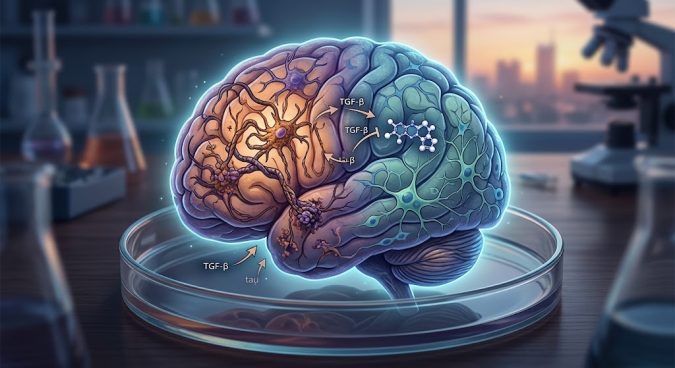
Published in Movement Disorders, the official journal of the International Parkinson and Movement Disorder Society, on October, 16, 2026, the study found that the inhibition of the receptor of a cytokine called TGF–β (transforming growth factor beta), which is involved in cell proliferation, differentiation, immune regulation, inflammation, and tissue repair, attenuates toxic protein accumulation (tau) and neurodegeneration in progressive supranuclear palsy.
“TGF-β1 is a brain injury–related cytokine, regulating neuronal development, immune response, and astrocytic reactivity; its receptor I is abundantly expressed on glial cells and the dysregulation of this pathway has been implicated in several neurodegenerative diseases… although the exact role of TGF-β signaling has remained controversial,” the researchers explained in the paper.
The Core of The Study
The experimental preclinical study used patient-derived organoids, cells obtained from the midbrain of four patients (two with PSP and two without disease).
The human cells were then turned into stem cells and harvested at 60 and 90 days to obtain 96 mini cerebral tissues (organoids). This allowed the researchers to compare the behavior of diseased and healthy cells.
Stem cells were treated with a TGF-β inhibitor (SB431542), other cells were supplemented with recombinant growth factors, and others remained untreated. At the end of the experimental therapy, the treated cells exhibited reduced Tau hyperphosphorylation, as well as reduced neurodegeneration and diminished astrocytic reactivity, whereas the untreated and recombined cells showed marked dopaminergic loss, neurodegeneration, protein accumulation, and neuroinflammation.
The Mechanism
To fully understand the pathological mechanism of neurodegenerative disorders, you need to understand what tau and phosphorylation are.
Tau is an important protein for neural health and stability. It belongs to the family of microtubules (Microtubule-Associated Proteins, or MAPs). It shapes the pillars of neurons and allows communication among them. In pathological conditions, tau protein develops a chemical anomaly, with an excess of phosphate molecules (hyperphosphorylation), and detaches from microtubules, which collapse. The altered tau protein begins to misfold and aggregate in toxic clusters and fibers, the so-called neurofibrillary tangles. The accumulation of these tangles blocks neurons and causes their death (neurodegeneration). This pathological mechanism is also called tauopathy and is associated with all neurodegenerative disorders. However, tau accumulation varies by the type of neurodegenerative disease. Alzheimer’s disease, for example, is a secondary tauopathy because tau is combined with amyloid plaques.
PSP, instead, is a primary tauopathy (or 4R tauopathy), because the accumulation is driven by four forms of tau protein.
The target of the experimental study was just progressive supranuclear palsy or PSP-4R, or PSP-Richardson’s syndrome, from the name of neurologist J. Clifford Richardson, who first identified the disease fifty years ago.
Relevance of the Study
The Italian experiment aimed at stopping PSP progression is extremely relevant because, by blocking the inflammatory cascade of the TGF-β cytokine, researchers have been able to reduce toxic accumulation of tau protein in brain organoids, paving the way for the development of drugs to treat this devastating neurodegenerative disease in humans.
“This study demonstrates that pharmacological blockade of TGF-β signaling significantly prevented phosphorylated tau accumulation, neurodegeneration, and astrogliosis in a PSP-RS patient-derived vMO model, providing proof-of-concept preclinical evidence supporting the potential relevance of this pathway as a therapeutic target in PSP,” the researchers stated in their paper.
TGF-β may be a therapeutic pathway more effective than GSK-3β (Glycogen Synthase Kinase-3 beta), an enzyme that is primarily responsible for hyperphosphorylation of the tau protein. So far, preclinical studies aimed at inhibiting GSK-3β have resulted toxic in humans, as the Italian study on TGF-β has shown a favorable safety profile on organoids of health patients.
Moreover, TGF-β inhibition has already been tested through a monoclonal antibody called fresolimumab in human clinical studies for cancer and fibrotic diseases, and the road to developing a similar monoclonal antibody for tauopathies and neurodegenerative diseases could not be so distant.
“This study is not without limitations. First, organoids were analyzed after 3 months of culturing (day 90), and longer observation was missing… A longer observation period, however, may allow a better detection of 4R-tau pathology, which tends to fully develop at later time points in experimental models,” the researchers affirmed in the paper.
Conclusion
The news about this crucial study on PSP is dedicated to my beloved uncle, who passed away from progressive supranuclear palsy in 2018. At the time of his disease, no hope was provided for his recovery and survival. I’m sure he would be happy to learn that a possibility to stop PSP progression is on the way.