Article checked and source verified by Journalist Rosalba Mancuso
When you sit in the dentist’s chair, you probably expect them to check for cavities, evaluate your gums, or remind you to floss. However, modern clinical science shows that your dental team does far more than safeguard your smile. They serve as a crucial line of defense for your entire body.
According to an insightful medical analysis published in BDJ Team (Nature Publishing Group), certain rare, systemic diseases show their very first warning signs inside the mouth. Chief among these is vasculitis—a complex condition where a routine dental checkup can mean the difference between a delayed diagnosis and life-saving medical intervention (Mills, J., BDJ Team, 2016).
Vasculitis Overview
Literally translated, vasculitis means inflammation of the blood vessels. However, as the BDJ Team study highlights, it is actually an “umbrella term” that encompasses a massive spectrum of illnesses. These range from mild, localized allergic reactions on the skin to severe, chronic, and potentially life-threatening autoimmune conditions (Mills, J., 2016).
In cases of Primary Systemic Vasculitis (PSV), the body’s immune system experiences a glitch. White blood cells called neutrophils, which are normally responsible for fighting off infections, become hyperactive. Instead of defending the body, they mistakenly target and attack the healthy cells lining your blood vessels (Mills, J., 2016).
When these vessel walls become inflamed, two dangerous things can happen:
- Restricted Blood Flow: The vessels narrow or clog, cutting off oxygen and vital nutrients to major organs, which can cause tissue death (necrosis).
- Leaky Vessels: Microscopic capillaries become fragile and leak blood into the surrounding tissue, creating distinct, purple-red rashes known medically as purpura (Mills, J., 2016).
Clinicians classify vasculitis into three main categories based on the size of the blood vessels under siege:
| Vessel Classification | Primary Targets in the Body | Potential Complications |
|---|---|---|
| Large Vessels | The aorta and major main arteries/veins | Widespread circulatory issues |
| Medium Vessels | Arteries supplying major organs (like the kidneys and intestines) | Organ damage or dysfunction |
| Small Vessels | Arterioles, venules, and microscopic capillary beds | Ulceration and tissue breakdown, especially in the skin, lungs, kidneys, and oral mucosa |
While medical science currently has no permanent cure for systemic vasculitis, specialized medications can successfully suppress the rogue immune response and guide patients into long-term remission (Mills, J., 2016).
Why Your Dentist Can Spot It
It might seem strange to think of a dentist identifying a serious vascular disease, but the logistics of modern healthcare make them ideal detectives.
Statistically, “healthy” individuals visit their dental practice far more regularly and consistently than they visit their primary care physician or GP. Furthermore, because a vast array of systemic, whole-body illnesses exhibit early symptoms in the face, jaw, and mouth, a routine oral exam is actually a holistic evaluation of your health status (Mills, J., 2016).
As BDJ Team notes, there are three specific types of aggressive vasculitis that leave highly distinct, identifiable “footprints” in the oro-facial region (Mills, J., 2016):
1. Granulomatosis with Polyangiitis (GPA)
Formerly known as Wegener’s Granulomatosis, this form of vasculitis is frequently associated with an abnormal circulating antibody known as ANCA (anti-neutrophil cytoplasmic antibody). GPA is highly aggressive and often impacts the nose, sinuses, lungs, and kidneys.
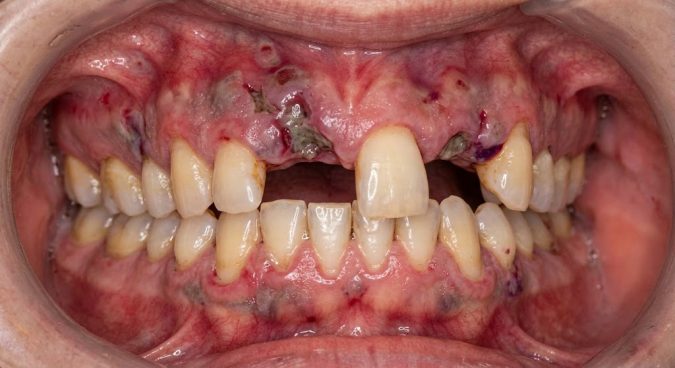
Inside the mouth, it can cause persistent, deeply eroding ulcers on the lips and lining of the mouth. Most distinctively, it can restrict blood flow to the gums, causing a bright red, bumpy, and swollen condition known as “strawberry gingivitis.” It can even cut off the blood supply to the teeth entirely, causing “phantom toothaches” or sudden nerve death (pulpal necrosis) in perfectly clean teeth with no cavities (Mills, J., 2016).
2. Giant Cell Arteritis (GCA)
Predominantly affecting older adults, GCA causes inflammation in the medium and large arteries of the head. While patients might initially dismiss symptoms as a simple headache or scalp tenderness when brushing their hair, a classic dental red flag is jaw or tongue claudication—which is severe pain or cramping in the jaw and tongue brought on specifically by the physical act of chewing food (Mills, J., 2016).
3. Behçet’s Syndrome
For individuals living with Behçet’s Syndrome, persistent and highly painful mouth sores are often the very first sign of trouble. These sores begin as raised, red swellings before breaking down into deep ulcers covered by a signature grayish membrane. These painful ulcers can spread across the soft tissues of the mouth, the hard palate, and deep into the throat (Mills, J., 2016).
The Path of Treatment & What Patients Must Know
Managing systemic vasculitis is highly complex and requires a coordinated medical strategy. The BDJ Team paper maps out the standard three-phase treatment timeline that clinicians use to manage the disease, along with vital warnings for patients undergoing dental procedures:
The Treatment Timeline & Dental Precautions
As said, the treatment for vasculitis usually involves three phases.
- Phase 1: Acute Induction: Bringing Active Disease Under Control.
Doctors first deploy heavy-hitting therapies to halt immediate organ damage. This typically involves high-dose corticosteroids (like prednisolone) combined with powerful immunosuppressant drugs or targeted monoclonal antibodies (such as cyclophosphamide or rituximab). Rituximab specifically targets the B-cells in bone marrow to stop them from producing the rogue signals activating the neutrophils (Mills, J., 2016).
2. Phase 2: Long-Term Maintenance: Preserving Remission Over Years.
Once the inflammation settles, patients transition to lower doses of steroids alongside milder maintenance immunosuppressants (such as azathioprine, methotrexate, or mycophenolate). This phase can last for several years to keep the disease dormant, though relapses remain common (Mills, J., 2016).
3. Phase 3: Navigating Dental Care Safely: Crucial Side Effect Management.
Because these medications intentionally suppress your immune system, patients become highly vulnerable to infections and blood clotting issues. Crucially, long-term steroid use can cause your adrenal glands to temporarily stop producing natural cortisol. Without checking this, a stressful surgical event like a tooth extraction could trigger medical shock. Furthermore, if you take bisphosphonates to protect your bones from steroid-induced osteoporosis, your jawbone’s ability to heal is reduced, elevating the risk of severe post-operative bone infections (Mills, J., 2016).
Joining the Dots for Your Health
The ultimate takeaway from the BDJ Team research is that early diagnosis completely transforms a patient’s prognosis. Before modern immunosuppressive therapies were introduced in the 1970s, severe forms of systemic vasculitis were almost universally fatal. Today, they are highly treatable, manageable chronic conditions (Mills, J., 2016).
Because early symptoms are often scattered across different areas of the body—a blocked sinus here, a painful jaw when eating there, or an unusual red rash on the gums—it can be incredibly difficult to diagnose. By carefully reviewing your medical history and recognizing these subtle oral warning signs, your dental team provides the missing pieces of the puzzle, ensuring you get the specialized medical attention you need right when it matters most (Mills, J., 2016).