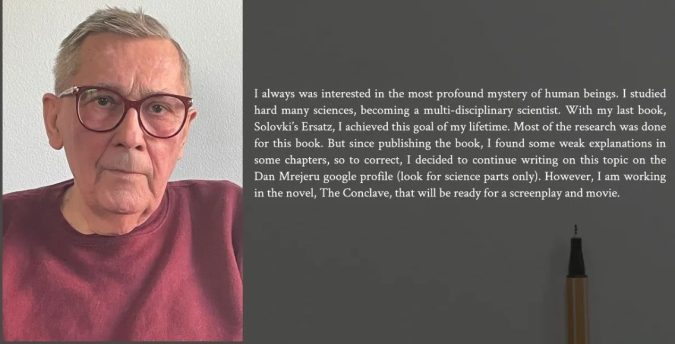
Dan M. Mrejeru is an independent researcher and writer passionate about neuroscience. Originally from Romania but living in the United States, and with a degree in geology, he has written and published several essays. His most famous is ” The Making, The Rise, and The Future of The Speaking Man,” a comprehensive collection of studies and articles on the evolution of the human brain. Through this book, in its sixth edition now, Dan M. Mrejeru provides insightful clues about the development of neurons in the brain, especially due to ionizing radiation emitted during several geological eras.
This is a particularly interesting discovery, because ionizing radiation is today considered the culprit of many neurodegenerative diseases, like Parkinson’s and Alzheimer’s, along with the cognitive decline in humans.
The scientific books by Dan M. Mrejeru also include “The Story of Homo Loquens” “Seven Essays on Creation” and the latest “Solovki’s Ersatz,” which marked his definitive consecration as an insightful scientist.
We met him to get to know him better and reveal the secrets and projects of his brilliant work as a writer and researcher.
Hi Dan, can you give us a brief description of yourself?
I simply consider myself an independent, multidisciplinary researcher.
Do you prefer to be called a writer, scientist, or researcher?
Researcher, with no doubt.
What drove your interest in scientific writing?
My first years at university sparked my interest in geophysical and cosmological phenomena and how they can influence life on Earth and human beings themselves.
How long have you been writing?
I started writing my first book in 1994, but I didn’t publish it until 2006.
How many books have you written?
Twelve so far, but many of my works also include updated editions. So, in total, including the first editions of books I’ve republished in subsequent editions, I’ve written twenty-five books.
Which of your works do you consider most significant?
I always consider the last things I write as important, because there, I record my most recent research and discoveries. I’m truly amazed by the interesting things I discover and write about as I progress through the work.
In your book, “The Making, the Rise, and the Future of the Speaking Man,” you explore various past, present, and future topics, such as the neural development in human beings and artificial intelligence. What does the rise of artificial intelligence mean for humans? Could it harm our cognitive abilities, such as thinking, speaking, and writing?
This is a very complex question. Certainly, the culture generated and fuelled by new technologies is having a significant impact on our human faculties. Personally, I consider AI an excellent tool for saving time when searching for information on specific science topics.
What message did you want to convey with The Making, the Rise, and the Future of the Speakingman and why did you write six editions of this book?
From the beginning, I’ve considered this book a work in progress. That’s why I’ve updated it with several editions. The book is still evolving. Readers will be able to discover the meanings of each edition through their own reading.
What is neuroscience for you?
It is the backbone and fundamental aspect of my work, which I deal with every day.
According to you, why are modern humans experiencing mental health problems? Climate change has something to do with that?
I will answer this question, first by quoting Google Search, AI, and secondly by another opinion I expressed in several of my books.
Google Search, AI, says:
“Human evolution caused mental illnesses primarily through a mismatch between ancestral adaptive traits and modern environments, where formally advantageous mechanisms become maladaptive… Traits like anxiety, depression (as energy conservation/social withdrawal), and ADHD likely provided survival advantages in hunter-gatherer times. For example, depression may have evolved to help early humans conserve energy during scarcity or avoid social conflict. Anxiety acted as a vital, high-alert system for identifying danger. Thus, natural selection prioritizes reproductive success over long-term health, sometimes leaving us vulnerable to mental disorders as byproducts of useful traits. Some traits, such as schizophrenia, may have evolved as a byproduct of complex genetic changes that facilitated the development of complex, intelligent brains.”
In addition what the mainstream scientists have agreed, I support the theory that the geomagnetic (like the geomagnetic excursions) and cosmogenic (like supernova events, solar minima and maxima) events, being responsible of the atmospheric concentration of C14 isotopes, led to a stimulation of additional pulses of ROS (reactive oxygen molecules producing oxidative stress), which caused additional pulses of neurogenesis, affecting the human brain distinctly.
The result is that low doses of C14 isotopes ingested through food in all biota, and pulses of neurogenesis in humans, may cause biopositive to bionegative effects. Thus, mental illnesses may reflect such bionegative effects.
And, hence, is humanity evolving or regressing?
This is an equally complex question. I initially described humanity as in regression, because for the last four to six thousand years, it has been in a phase of advanced linearity.
Linear thinking, based on learning from what we see, is inferior to nonlinear thinking, which is based on creativity and emotions. Progress depends on the latter. Visionaries have always created, while those who adapt to reality (i.e., linear thinkers) live but don’t progress. In my case, I consider myself a nonlinear person. Today, the system fosters linearity, while nonlinear thinkers are often ignored.
What do you think of all that is happening in the contemporary world?
There is a clash and a confrontation between East and West. But this, too, in my opinion, depends on genetic factors. Genetics has produced different thoughts and behaviours between East and West.
Do you prefer writing fiction, nonfiction, or both?
Nonfiction is the genre I write in as a researcher, while fiction is what I wrote in two of my first books. I have always validated and demonstrated the hypotheses I discuss in my essays. What I write, therefore, is not science fiction, but genuine scientific research tested by valid experiments.
Is there a message you would like to leave to those who follow you?
My work has led me to ideas I never would have imagined, or that would never have existed, or that I would not have been able to address as I do today. In my latest scientific text, available on Academia.edu, I further describe the geological phenomenon of lowering temperatures and how it has supported the evolution of our civilization and the development of neurons in our brain. Matter is constantly evolving, which is why my work is also constantly evolving.
I’d like to conclude (and this goes beyond the space I have available) that this research has proved to be a formidable adventure for me, almost an obsession. I love writing the history of human evolution. I truly hope it may really contribute to expanding the knowledge about the development of our powerful and precious brains.
This interview was conducted and adapted into English by Journalist Rosalba Mancuso