Article checked and sources verified by Journalist Rosalba Mancuso –
The Nipah virus (NiV) represents one of the most formidable challenges to global health security in the 21st century. Recognized by the World Health Organization (WHO) as a “priority disease” due to its high fatality rate and lack of effective treatments, Nipah is a zoonotic pathogen that bridges the gap between wildlife and human populations. While outbreaks have historically been localized to South and Southeast Asia, the virus’s ability to cause severe respiratory distress and fatal brain complications makes it a constant subject of international surveillance.
As of early 2026, the virus has re-emerged in the headlines, following confirmed cases among healthcare workers in West Bengal, India, and ongoing seasonal clusters in Bangladesh. This article provides an in-depth exploration of the virus, its clinical profile, the mechanisms by which it spreads, and the threat it poses to humanity.
What is the Nipah Virus?
Nipah virus is a member of the Henipavirus genus, belonging to the Paramyxoviridae family. It is an enveloped, single-stranded RNA virus. It was first identified in 1998 during a massive outbreak among pig farmers in Kampung Sungai Nipah, Malaysia, from which the virus takes its name.
The natural reservoir for NiV is the fruit bat (also known as the “flying fox”) of the Pteropodidae family, specifically the Pteropus genus. Unlike many other viruses that kill their hosts, fruit bats carry Nipah asymptomatically, shedding the virus in their saliva, urine, and excreta without falling ill themselves.
A Tale of Two Strains
Researchers have identified two distinct genetic lineages:
- NiV-Malaysia (NiV-M): The original strain identified in 1998, which primarily spread from bats to pigs, and then from pigs to humans.
- NiV-Bangladesh (NiV-B): The strain responsible for more recent outbreaks in Bangladesh and India. This strain is particularly concerning because it demonstrates a higher rate of human-to-human transmission and a significantly higher mortality rate.
Transmission Pathways: From Forest to Floor
Nipah virus is highly versatile in its transmission, utilizing both direct and indirect routes to enter the human population.
Zoonotic Spillover (Animal-to-Human)
The primary “spillover” event occurs when humans come into contact with the bodily fluids of infected bats or intermediate hosts like pigs.
- Contaminated Food: In Bangladesh and India, the most common route is the consumption of raw date palm sap. Bats often roost in or near date palm trees and urinate into the collection pots used by locals.
- Infected Fruits: Fruits partially eaten or licked by bats can carry viable virus for several days.
- Intermediate Hosts: In the 1998 Malaysia outbreak, pigs acted as “amplifying hosts.” Bats dropped contaminated fruit into pig pens; the pigs became highly infectious and transmitted the virus to farmers through respiratory droplets.
Human-to-Human Transmission
Unlike the related Hendra virus, Nipah (especially the NiV-B strain) can spread directly between people. This usually occurs through:
- Close Contact: Exposure to the secretions or excretions of an infected person.
- Healthcare Settings: “Nosocomial” transmission is a major risk. In January 2026, two nurses in West Bengal were confirmed to have contracted the virus while providing care, emphasizing the danger to frontline workers.
Symptoms and Clinical Progression
The incubation period for Nipah virus typically ranges from 4 to 14 days, though rare cases have been documented with incubation periods as long as 45 days.
Early Symptoms
Infection often begins with non-specific, flu-like symptoms:
- High fever and chills
- Severe headache
- Myalgia (muscle pain)
- Sore throat and persistent cough
Severe Complications
As the virus progresses, it targets the lungs and the brain:
- Acute Respiratory Distress: Many patients develop atypical pneumonia, leading to severe breathing difficulties.
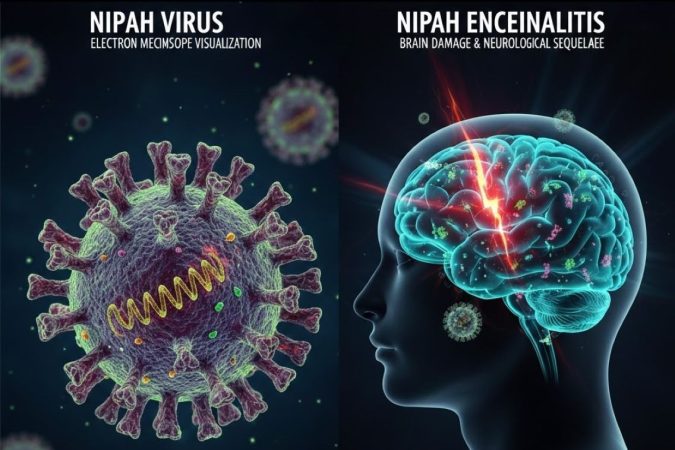
- Fatal Encephalitis: This is the hallmark of severe Nipah. The virus causes inflammation of the brain, leading to dizziness, altered consciousness, and coma (often within 24 to 48 hours of neurological onset).
The Nipah virus is also known to cause significant and often permanent personality changes and neuropsychiatric sequelae due to the extensive damage it inflicts on the brain’s frontal lobes and limbic system.
Research into survivors—particularly from the 1999 Singapore/Malaysia outbreaks—has provided documented cases of these profound shifts in character and behavior.
1. The Singapore Cohort Study (2004)
One of the most authoritative studies followed nine survivors for 24 months post-infection. The researchers discovered that the virus does not just affect memory; it rewires the survivor’s emotional landscape.
- Case of “Emotional Lability”: Two of the nine patients were clinically diagnosed with “personality changes” directly attributed to encephalitis. These individuals exhibited a “short fuse,” becoming easily frustrated, irritable, or aggressive over minor issues that would not have bothered them previously.
- Depressive Shifts: Five patients developed Major Depressive Disorder. Unlike standard depression, these cases were linked to physical brain lesions. One patient refused all psychiatric intervention and remained in a state of chronic, treatment-resistant depression and apathy for the duration of the study.
2. Behavioral Changes and “Frontal Lobe Syndrome”
Because Nipah often causes multiple small lesions in the brain’s white matter, survivors can exhibit symptoms similar to Frontal Lobe Syndrome. Reported cases include:
- Impulsivity and Disinhibition: Survivors have been documented acting without “tact,” making inappropriate social comments, or engaging in risky behaviors (such as reckless spending or promiscuity) that were entirely out of character for them before the illness.
- Apathy and Flat Affect: Family members of survivors in Malaysia and Kerala, India, have reported that their loved ones seemed “emotionally numb” or “extroverted” in a way that felt hollow, as if the person’s original essence had been replaced.
3. Chronic Neuropsychiatric Symptoms
A 10-year follow-up study of Malaysian survivors published in Neurology Asia highlighted that the psychological impact is not just a phase of recovery but a permanent state for many.
- Irritability and Outbursts: Approximately 8-10% of survivors in long-term tracking reported persistent “personality changes” characterized by sudden emotional outbursts.
- Cognitive-Personality Overlap: Patients often struggle with “attention deficits,” which manifests as a personality change where the individual appears constantly distracted, disinterested, or socially “removed” from conversations.
Long-term Effects and Relapse
Survival does not always mean a full recovery. Approximately 20% of survivors suffer from persistent neurological conditions, such as seizure disorders or the personality changes described above. Furthermore, “latent” Nipah can occur, where the virus remains dormant and causes a fatal relapse of encephalitis months or even years later.
How Dangerous is Nipah?
By almost any metric, Nipah is one of the deadliest viruses known to man.
Mortality Rates
According to the World Health Organization, the case fatality rate (CFR) is estimated to be between 40% and 75%. In some localized outbreaks in India and Bangladesh, the death rate has soared above 90%. To put this in perspective, the CFR for COVID-19 is generally estimated at less than 1%, and even Ebola typically averages around 50%.
Treatment and Prevention
There is currently no licensed vaccine or specific antiviral drug for Nipah virus. Treatment is limited to “supportive care”—managing fever and maintaining hydration.
“The lack of specific treatments and the high mortality rate make Nipah a pathogen of significant epidemic potential,” states a WHO 2025 technical brief.
While experimental treatments like monoclonal antibodies (m102.4) and the world’s first Phase II vaccine trials (launched in December 2025 by the University of Oxford) are underway, they are not yet available for general use.
Global Risk and Pandemic Potential
While Nipah outbreaks are currently sporadic, the virus is considered a major pandemic threat. Fruit bats of the genus Pteropus are found across a massive geographical range, including Australia, Southeast Asia, and parts of Africa.
The European Centre for Disease Prevention and Control (ECDC) and the CDC monitor these regions closely. The risk lies in the virus evolving to become more easily transmissible through the air (respiratory droplets), which could turn a localized outbreak into a global crisis.
“Nipah virus is one of the pathogens in the WHO Research & Development Blueprint list of epidemic threats needing urgent R&D action” affirmed officers at the WHO.
Regarding the recent West Bengal cases, Indian authorities emphasized that “Containment through contact tracing and isolation remains our only viable defense against this virus.”
Bottom Line
The Nipah virus is a stark reminder of the fragile interface between human expansion and wildlife habitats. With a staggering death rate and the ability to spread between humans, it remains a “clear and present danger.” Vigilant surveillance, avoiding raw food, and strict hospital hygiene remain our only effective tools until a vaccine is fully realized.
References
- World Health Organization (WHO): Nipah virus fact sheet (Updated January 29, 2026).
- Centers for Disease Control and Prevention (CDC): Nipah Virus: Facts for Clinicians (2024-2026 guidelines).
- World Health Organization (WHO): Nipah Virus Update: West Bengal, India (January 2026).
- National Centre for Disease Control (NCDC), India: CD Alert – Nipah Virus Disease (January 2026).
- Ng, B. Y., et al. (2004): “Neuropsychiatric Sequelae of Nipah Virus Encephalitis.” The Journal of Neuropsychiatry and Clinical Neurosciences. (Detailed follow-up of the Singapore outbreak cases).
- Neurology Asia (2009): “Ten year clinical and serological outcomes of Nipah virus infection.” (Long-term data on personality and fatigue).
- CDC Clinician Portal (2026): “Nipah Virus: Facts for Clinicians.” (Lists “personality changes” among long-term effects).
- Encephalitis Society: “Emotional and behavioural difficulties after encephalitis.” (General clinical framework for how viral brain inflammation alters personality).
- CEPI (2025): “University of Oxford launches world’s first Phase II Nipah virus vaccine trial.”